Email to schedule an appointment: contactus@abatis.ch


Abatis Deterministic eXecution Integrity and International Cybersecurity Frameworks
Why Modern Security Standards Naturally Converge on Prevention, Integrity and Sovereign Control
Modern cybersecurity frameworks increasingly converge on the same engineering objectives: trusted execution, system integrity, operational resilience, auditability and sovereign control. Although developed independently, frameworks such as NIS2, DORA, ISO/IEC 27001, NIST CSF 2.0, NIST SP 800-207, IEC 62443, CIS Controls v8, PCI DSS and the EU Cyber Resilience Act all seek to reduce cyber risk through demonstrable technical control.
Abatis implements Deterministic eXecution Integrity (DXI), a kernel level preventative execution control that prevents unauthorised executable persistence and execution before compromise can occur. DXI is not a compliance framework. It is a foundational technical control that helps organisations implement many of the preventative objectives required by modern standards.
Modern frameworks share common objectives.
THE FIVE COMMON OBJECTIVES OF MODERN CYBERSECURITY
Objective
DXI Contribution
Trusted Execution
Only authorised executable code may persist or execute.
System Integrity
Maintains a known trusted system state.
Operational Resilience
Prevents disruption by stopping unauthorised execution.
Auditability
Produces deterministic enforcement events.
Sovereign Control
Local enforcement without cloud dependency.

DXI supports technical implementation.
ARCHITECTURAL OBSERVATION
European legislation, American standards, industrial cybersecurity standards and financial regulations have evolved independently. Nevertheless, they increasingly require the same architectural outcomes. This convergence suggests that cybersecurity is moving towards a model based on integrity, prevention and resilience rather than post-compromise detection.
Prevention complements compliance.
FRAMEWORK ALIGNMENT
NIS2
Supports resilience, risk reduction and protection of essential services.
DORA
Supports ICT resilience and operational continuity.
ISO/IEC 27001
Strengthens malware protection, integrity, change control and hardening.
NIST CSF 2.0
Supports Protect, Detect, Respond and Recover functions.
NIST SP 800-207
Extends Zero Trust principles to executable code.
CIS Controls v8
Supports application control, software inventory and malware defences.
IEC 62443
Well suited to OT and ICS through deterministic operation.
PCI DSS v4
Strengthens integrity and malware prevention.
SWIFT CSP
Supports trusted execution and controlled change.
GDPR Article 32
Supports technical security measures protecting processing environments.
EU Cyber Resilience Act
Complements secure by design and lifecycle resilience objectives.
Secure by Design
Implements preventative runtime enforcement.
MITRE ATT&CK and Prevention First
MITRE ATT&CK describes attacker behaviour after execution begins. DXI prevents many ATT&CK techniques from occurring at all, meaning deterministic prevention may appear underrepresented in ATT&CK style evaluations despite preventing compromise earlier in the attack lifecycle.
Software Bill of Materials (SBOM)
An SBOM identifies what software should be present. DXI enforces what software is actually allowed to execute. Together they provide inventory and runtime assurance.
Cyber Sovereignty
DXI supports sovereign architectures through local policy enforcement, no mandatory cloud dependency, operation in air-gapped environments, local audit evidence and reduced reliance on external intelligence services.
DXI is particularly well suited to Saudi, GCC and other sovereign architectures where local control, regulated infrastructure, data residency expectations and minimal dependence on foreign cloud telemetry are strategic requirements.
A foundation rather than a certification.
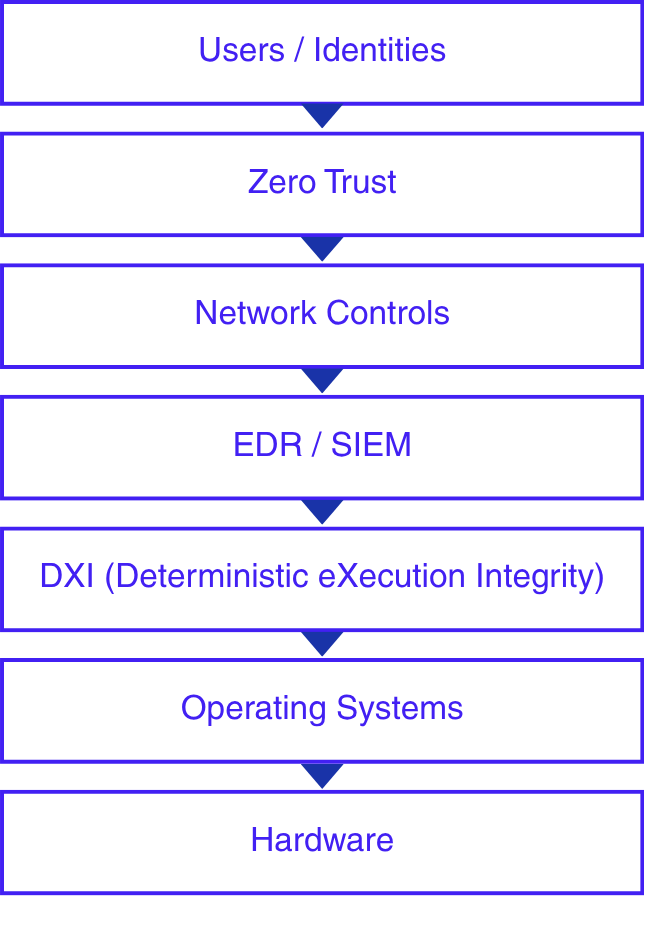
WHERE DXI FITS IN MODERN SECURITY ARCHITECTURE
WHAT ABATIS DOES NOT CLAIM
DXI does not itself certify compliance with any regulation or standard. It complements governance, risk management and organisational controls by providing a deterministic preventative execution layer.
A COMMON DIRECTION
Cybersecurity frameworks will continue to evolve, but their engineering objectives are increasingly aligned. Deterministic execution, trusted system integrity and operational resilience are becoming universal requirements. DXI provides a preventative technical foundation that naturally supports these objectives across government, critical infrastructure and enterprise environments.
Ready to learn more?
Explore our research.
Want to see DXI in practice?
Speak with our team!